

Help Pages
InClover In-Depth Report Help Section
This report contains a large range of relevant stats for each horse in the race. Great for an eye-friendly PDF or printout. For more detailed analysis and horse-to-horse comparison for different stats, try using some of our other helpful and insight-filled reports.
Report Sections
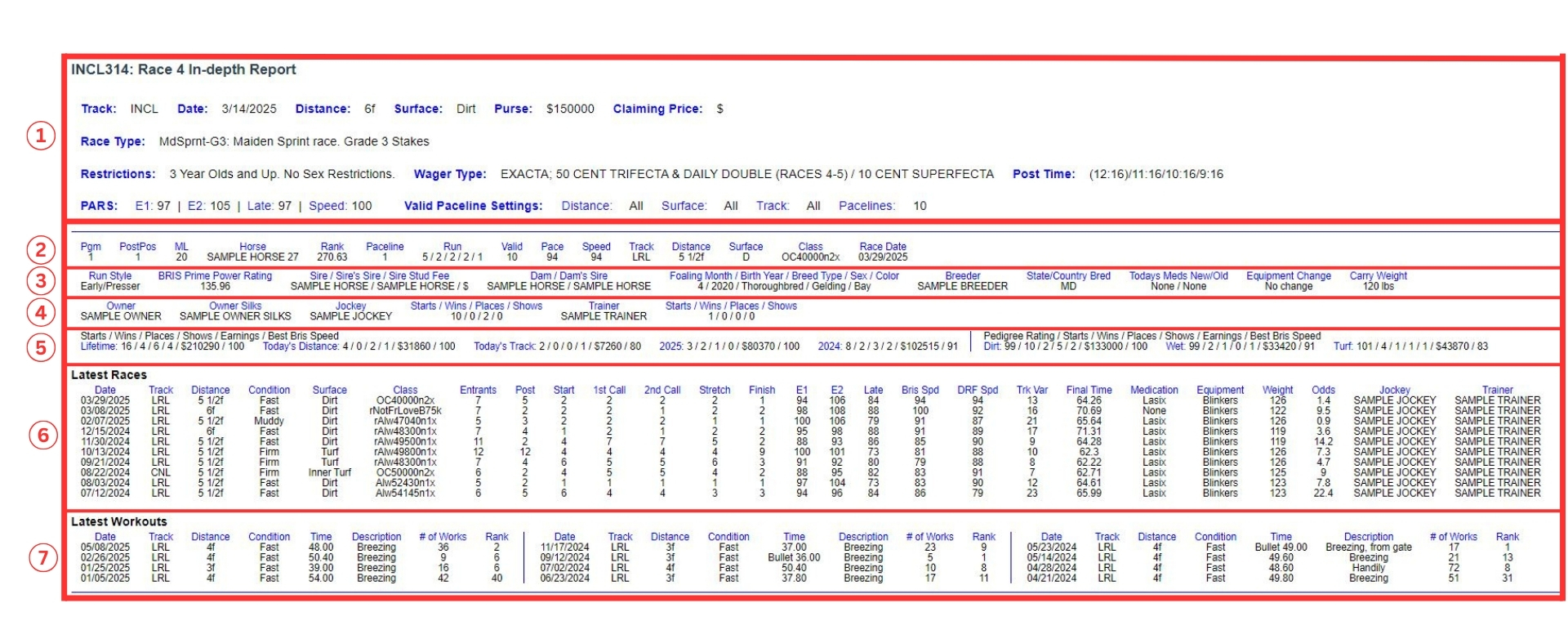
1. Race Information
- Date: Date of the race
- Track: Track code for the track where the race will be held.
- Distance: Distance of the race in furlongs/miles.
- Surface: The surface on which the race will be held on.
- Race Type: Race class code followed by a breakdown of what the class code means.
- Purse: Total prize money offered for the race.
- Claiming Price: Claiming price for the race, if applicable. A claiming price is the set amount to buy a horse in a claiming race. This will be left blank if race is not a claiming race.
- Restrictions: Horse age and sex restrictions for the race.
- Wager Types: Types of wagers for this race.
- Post Time: Scheduled start time for the race. Formatted Eastern/Central/Mountain/Pacific timezone. Parentheses indicate the timezone where the race is taking place.
- Pars: Represent a performance benchmark for the race’s specific class, distance, and conditions. These are used to evaluate how fast the race is likely to go and how each horse measures up.
- E1: The Brisnet par speed performance benchmark for the first 2 furlongs of the race.
- E2: The Brisnet par speed performance benchmark for the first 4 furlongs of the race.
- Late: The Brisnet par speed performance benchmark for the remainder of the race after the first 4 furlongs of the race.
- Speed: The Brisnet par speed performance benchmark for the entire race.
- Valid Paceline Settings: These are paceline settings for the InClover Classic Page that were set when the report was generated. These settings determine what data is shown in the Horse’s Classic View Row.
2. Horse’s Classic View Row
- Pgm: The horse’s program number for the race.
- PostPos: The horse’s post position for the race. This refers to the number of the starting gate stall.
- ML: The horse’s morning line odds for the race. The morning line odds are the initial odds set by the track’s oddsmaker before betting begins on the race.
- Horse: The horse’s name.
- Rank: InClover’s speed ranking for the filtered pacelines.
- Paceline: Which of the last ten pacelines is being shown in the table. 1 being the most recent paceline. 10 being the oldest paceline.
- Run: For the most recent valid paceline: Post Position/Start Call Position/2nd Call Position/Stretch Position/Finish Position.
- Valid: How many of the horse’s last ten races are being included by the paceline filter settings. Most notably, this is the sample size for the horse’s InClover speed ranking.
- Pace: Bris E1 pace figure for the most recent valid paceline.
- Speed: Bris Speed Rating for the most recent paceline. If no Bris speed rating is available, DRF speed rating will be used instead.
- Track: Track code for the track where the most recent valid paceline was held.
- Distance: Distance of the most recent valid paceline in furlongs/miles.
- Surface: Surface of the most recent valid paceline.
- Class: Race class code for the most recent valid paceline.
- Race Date: Date of the most recent valid paceline.
- Nasal Strip Change: Indicates any change in the horse’s nasal strip equipment for today’s race (added, removed, or unchanged).
ALLWAYS Only Terms:
- Back Class: Best class rating the horse has competed at in the last 12 months.
- Back Speed: Best Bris speed the horse ran in the last 12 months.
- ACL: Bris class rating based on recent good performances. (* indicates the rating is not using races of the same category and surface as the current race)
- Current Class: The horse’s class rating for the current race.
- Avg Class Last 3: Average class rating of the last three races.
3. Horse and Breeding Information
- Run Style: The horse’s typical racing tactic. This helps assess race dynamics and potential pace scenarios.
- Early: The horse likes to break quickly and set or contest the lead from the start. It does its best running on the front end and often tries to “wire” the field.
- Early/Presser: The horse is a versatile runner that can either set the pace or sit just off the leaders. It is usually close to the front early and can adapt to different pace scenarios.
- Presser: The horse prefers to track just behind the leaders early on. It will conserve energy before making a move around the far turn.
- Sustainer/Closer: The horse usually settles near the back of the pack early and relies on a strong late run in the stretch to pass tiring rivals.
- BRIS Prime Power Rating: A proprietary Brisnet rating that combines speed, class, and pace factors into a single number to estimate a horse’s overall win potential.
- Sire: The horse’s male parent (father).
- Sire’s Sire: The horse’s grandfather on the male side (paternal grandfather).
- Sire Stud Fee: The advertised cost to breed a mare to the sire for a given season. Higher fees often reflect the sire’s racing success or proven record as a producer of winners.
- Dam: The horse’s female parent (mother).
- Dam’s Sire: The horse’s grandfather on the female side (maternal grandfather).
- Foaling Month and Birth Year: Birth month/year of the horse.
- Breed Type: Horse’s breed registry classification.
- Appaloosa
- Arabian
- Paint/Pinto
- Quarter Horse
- Thoroughbred
- Non-Thoroughbred (in TJC registry)
- Sex: Defines the horse’s sex/age classification.
- Colt: A male horse under 5 years old that has not been gelded (castrated). Colts are typically still in training or early racing careers.
- Horse: A mature male horse (usually 5 years or older) that is not gelded. Often used interchangeably with stallion, but may appear as “Horse” in racing records.
- Gelding: A male horse that has been castrated, usually to improve behavior and manageability.
- Filly: A female horse under 5 years old. Fillies may compete against other fillies or mixed company in races.
- Mare: A female horse aged 5 years or older. Mares are eligible for breeding and often retire from racing to become broodmares.
- Ridgling: A male horse with one or both testicles undescended. May behave like a stallion but is often sterile or has limited fertility.
- Stallion: An uncastrated adult male horse, used for breeding purposes. Stallions may race, but many retire early to stud.
- Entire: Another term for a fully intact male horse (not gelded), often used in European racing or breeding records; similar to “stallion” in meaning.
- Color: Describes the coat color of the horse.
- Breeder: The person or farm that owned the mare (dam) at the time she gave birth to the horse.
- State/Country Bred: Shows where the horse was foaled. This can determine eligibility for state-bred or regionally restricted races and incentive programs.
- Today’s Meds New/Old: Indicates whether the horse is receiving a medication today (e.g., Lasix) and if it’s a new addition, being removed, or unchanged from its last start—useful for spotting changes in conditioning or strategy.
- Equipment Change: Lists any changes in racing gear since the horse’s last start (e.g., adding blinkers or removing them), which may affect performance or behavior.
4. Owner, Jockey, and Trainer Information
This section contains information on the horse’s owner, trainer, and jockey. Here is the meaning of each of the terms in the stat lines:
- Starts: Number of races participated in.
- Wins: Number of first-place finishes.
- Places: Number of second-place finishes.
- Shows: Number of third-place finishes.
5. Horse’s Stats
This section contains the horse’s career stats for different timeframes, distances, tracks, and surfaces.
- Lifetime: Horse’s lifetime stats. Includes every race the horse has participated in.
- Today’s Distance: Horse’s lifetime stats for races with the same distance as today’s race.
- Today’s Track: Horse’s lifetime stats for races on the same track as today’s race.
- Current Year: Horse’s stats for the current year. In the sample image above, this is 2025.
- Previous Year: Horse’s stats for the previous year. In the sample image above, this is 2024.
- Dirt: Horse’s lifetime stats for races that took place on dirt.
- Wet: Horse’s lifetime stats for races that took place in wet/muddy conditions.
- Turf: Horse’s lifetime stats for races that took place on turf.
Here is the meaning of each of the terms in the stat lines:
- Starts: Number of races participated in.
- Wins: Number of first-place finishes.
- Places: Number of second-place finishes.
- Shows: Number of third-place finishes.
- Earnings: Total winnings the horse has earned from the races included in the stat line.
- Best Bris Speed: The best Brisnet par speed performance benchmark the horse achieved during the races included in the stat line.
- Pedigree Rating: Brisnet’s proprietary numerical score that estimates how well the horse is genetically suited to perform on that specific surface. These ratings are calculated based on the historical performance of the horse’s sire, dam, and often other close relatives on those surfaces.
6. Last Ten Pacelines Data
- Date: Date of the past race.
- Track: Track code for the track where the past race was held.
- Distance: Distance of the past race.
- Condition: Conditions of the track when the past race was held.
- Surface: The surface the past race was held on.
- Class: Class code of the past race. See our pars report for a detailed description of each paceline’s class code.
- Entrants: Number of horses that participated in the past race.
- Post: The horse’s post position for the race. This refers to the number of the starting gate stall.
- Start: (Start Position) The horse’s position relative to the field just after the gate opens, typically within the first few strides or at the first timing point.
- 1st Call: (First call position) The horse’s position in the field at the first recorded point of call, often after the first quarter-mile or 2nd furlong marker. This gives early race context and aligns with the horse’s E1 par stat.
- 2nd Call: (Second call position) The horse’s position in the field at the second recorded point of call, typically around the half-mile or 4th furlong marker. This reflects mid-race positioning and aligns with the horse’s E2 par stat.
- Stretch: (Stretch position) The horse’s position in the field as it enters the final stretch, usually around the 5th furlong marker in a 6-furlong sprint. This shows how the horse was positioned just before the final drive to the wire and helps assess finishing ability.
- Finish: (Finish Position) The horse’s final standing at the wire. Determines placing (1st, 2nd, 3rd, etc.) and payout eligibility for win/place/show wagers.
- E1: The Brisnet par speed performance benchmark for the first 2 furlongs of the race.
- E2: The Brisnet par speed performance benchmark for the first 4 furlongs of the race.
- Late: The Brisnet par speed performance benchmark for the remainder of the race after the first 4 furlongs of the race.
- Bris Spd: The Brisnet par speed performance benchmark for the entire race.
- DRF Spd: The Daily Racing Form par speed performance benchmark for the entire race.
- Trk Var: A numerical value that measures how fast or slow the track surface played on a particular day, relative to par times for each class and distance. It’s designed to account for fluctuations in track speed due to weather, maintenance, or surface conditions.
- Final Time: The horse’s official time to complete the race, recorded from the starting gate to the finish line.
- Medication: What medication, if any, the horse received, most commonly Lasix (furosemide), used to reduce bleeding.
- Equipment: Lists any special racing gear the horse wore.
- Weight: The total number of pounds the horse carried during the race, including the jockey and gear.
- Odds: The final betting odds for the horse when the race began.
- Jockey: The horse’s jockey for the past race.
- Trainer: The horse’s trainer for the past race.
ALLWAYS Only Terms:
- Class Rating: Horse’s class rating for that paceline.
7. Last Twelve Workouts Data
- Date: Date of the workout
- Track: Track code for the track where the workout was held.
- Distance: The distance of the timed workout. Longer distances can indicate stamina-building efforts.
- Condition: Conditions of the track when the workout was held.
- Time: The official clocked time it took the horse to complete the workout at the specified distance. A bullet workout is the fastest time of the day at that distance and signals an especially strong workout compared to peers.
- Description: Additional notes about the workout that describe how the horse was moving and how much effort was being asked by the rider. Common workout description terms:
- Handily: The horse worked at an easy, controlled pace without being asked to accelerate much, showing a relaxed but steady effort.
- Breezing: The horse was asked to move with more energy and speed than handily, but still under control, usually considered a solid workout effort.
- From Gate: The workout started right from the starting gate, simulating an actual race break to help the horse practice its start and early speed.
- Dogs Up: The horse finished the workout running strongly and in clear control, often pulling away from other horses or the rider’s urging, a sign of a confident and fit effort.
- # of Works: The total number of official workouts the horse has recorded during its current training cycle or in its lifetime. A higher number may suggest an active or well-conditioned horse.
- Rank: The horse’s position relative to all others who worked the same distance on the same day at that track, ranked by fastest recorded workout time, with 1 indicating the quickest time.
8. ALLWAYS Only: Recent Scratches Section
- Date: Date of the race the horse was scratched from.
- Track: Track of the race the horse was scratched from.
- Race #: Race number of the race the horse was scratched from.
- Class: Class of the race the horse was scratched from.
- Reason: The reason why the horse was scratched from the race.